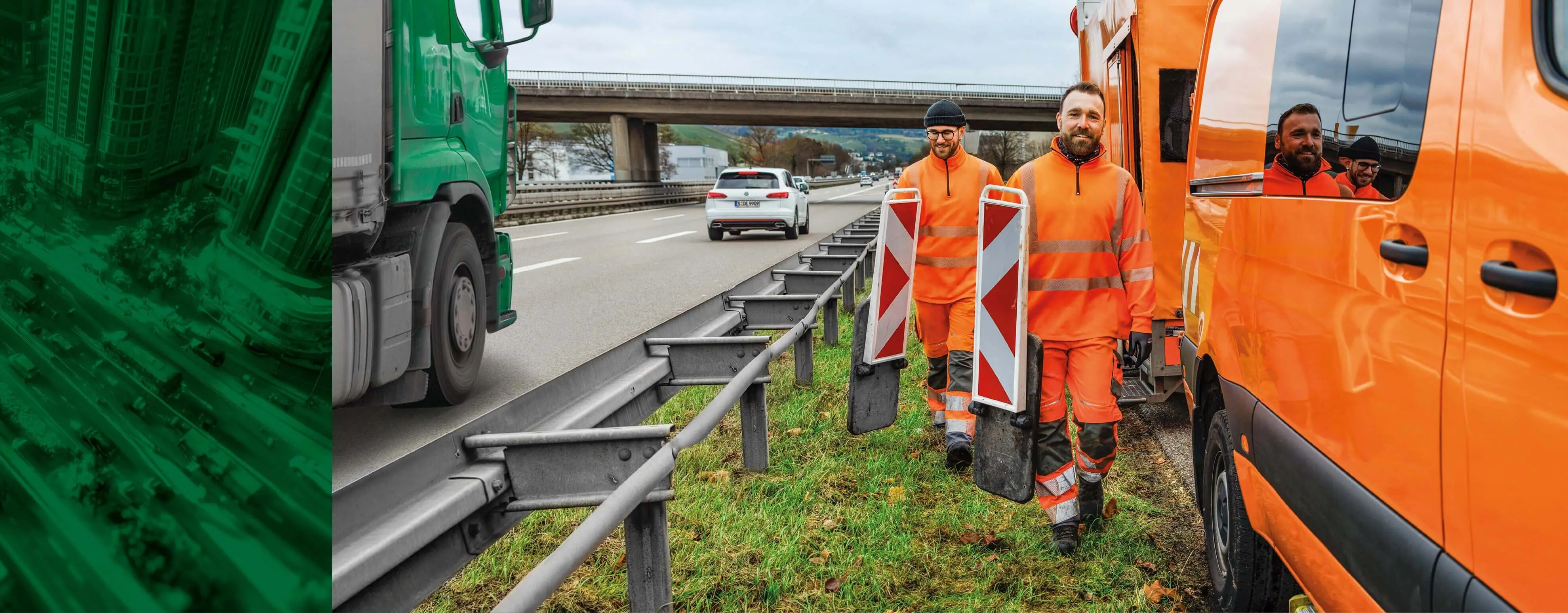
These three examples alone clearly demonstrate the wide-ranging impact and the associated challenges when our roads are workplaces. Many people suffer severe or fatal injuries every year due to traffic accidents at their workplaces. This makes it essential to take a closer look at the issue and analyze what is causing and driving it. We also need to explore which measures we can take to ideally prevent such accidents, or at least mitigate their consequences. The fact that the German Road Safety Council and the European Transport Safety Council, for example, have recently written publications on this very topic shows how urgent this task is.
This is the 19th consecutive issue of the DEKRA Road Safety Report, and this time it examines the various problems that arise when our roads are workplaces. It looks at the topic through the lens of accident analysis, traffic psychology, vehicle technology, infrastructure design, and legislation and sets out potential solutions. The fact is that professional drivers, emergency personnel, and many others whose workplace is the road all bear a great deal of responsibility every day. They drive large vehicles, work under time pressure, and need to react quickly and correctly in dynamic traffic situations. We also increasingly need to direct our attention beyond the vehicles themselves. Safe work zones and construction sites, adequate parking, and reliable organizational workflows are key to eliminating accidents in our everyday working lives.
DEKRA has once again conducted extensive road tests and crash tests specifically for this Road Safety Report, in order to find out how vehicles, assistance systems, and safety equipment actually behave when put to the test in real-life scenarios. Our tests on different ways of securing road work sites, the tests looking at how well modern automated emergency braking systems can detect and react to mobile warning signs or trailers, and the road tests with vans carrying different types of loads all provide important insights for future technical requirements and safety standards. Our survey of professional drivers on the parking situation and level of safety and security at rest stops in Germany and other European countries also revealed some interesting findings.
This issue of the DEKRA Road Safety Report again includes statements from numerous renowned national and international experts and underlines once more just how varied the factors are that influence safety when it comes to our roads as a workplace. It also illustrates that lasting improvements can only be achieved by tackling the topic holistically. Technical innovation, clear rules, safe infrastructure, and responsible conduct must all go hand in hand. DEKRA’s mission is to play an active role in shaping this process. I hope you find this report a stimulating read.